Quasi-Internal Frame#
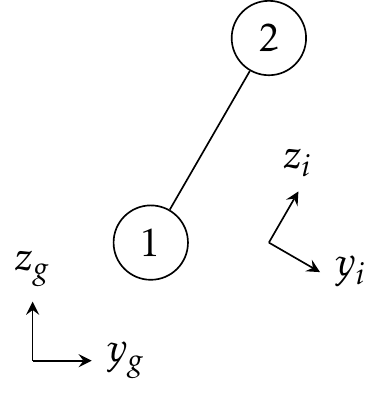
Fig. 2 Global frame g and QI frame i of atoms 1 and 2. The z direction of this QI frame is chosen along the distance vector.#
Rotation Matrix#
Consider two vectors u, v and two reference frames A, B. R is the rotation matrix of the axes such that
Since \(u_A^T v_A=u_B^T v_B\),
A 2-D tensor, e.g., quadrupole moment Q, in two reference frames are associated by
It is easy to prove that
Two common transformations used in Tinker are:
From (A) Local Frame (in which parameters are provided) to (B) Global Frame (in which the calculation is done);
From (A) Global Frame (for direct pairwise electrostatics) to (B) Quasi-Internal (QI) Frame (for optimized algebra), as shown in Fig. 2.
Multipole Interaction in QI Frame#
Once the distance vector is in QI frame, many derivatives can be simplified as shown in the following table. f(r) does not explicitly depend on \(r_x,r_y,r_z\).
Gradients |
Global Frame |
QI Frame |
|---|---|---|
\(\partial f(r)/\partial x_2\) |
\(f'(r)r_x/r\) |
0 |
\(\partial f(r)/\partial y_2\) |
\(f'(r)r_y/r\) |
0 |
\(\partial f(r)/\partial z_2\) |
\(f'(r)r_z/r\) |
\(f'(r)\) |
For potential energy, (4) can be used without modification in QI frame. Since \(\partial\phi_1/\partial z_1 = -E_{z1}\), the z direction gradient can be obtained from z direction electrostatic field (Ez):
Once the torques are computed the same way as in the previous section
x and y direction gradients then become
Depending on the direction of distance vector, the signs of x and y direction gradients may flip.
Details#
In the following notes, \(A : B\) stands for \(A = A + B\). If there is no ambiguity, \(f'\) and \(f''\) may stand for \((f'_x,f'_y,f'_z)\) and \((f''_{xx},f''_{yy},f''_{zz},f''_{xy},f''_{xz},f''_{yz})\), respectively.
Potential Terms |
Notes |
|---|---|
\(\phi_1\) |
\(\phi_1\) |
\(\phi'_{1x}\) |
\(\partial\phi_1/\partial x_1\) |
\(\phi'_{1y}\) |
\(\partial\phi_1/\partial y_1\) |
\(\phi'_{1z}\) |
\(\partial\phi_1/\partial z_1\) |
\(\phi''_{1xx}\) |
\(\partial^2\phi_1/\partial x_1^2\) |
\(\phi''_{1yy}\) |
\(\partial^2\phi_1/\partial y_1^2\) |
\(\phi''_{1zz}\) |
\(\partial^2\phi_1/\partial z_1^2\) |
\(\phi''_{1xy}\) |
\(\partial^2\phi_1/\partial x_1\partial y_1\) |
\(\phi''_{1xz}\) |
\(\partial^2\phi_1/\partial x_1\partial z_1\) |
\(\phi''_{1yz}\) |
\(\partial^2\phi_1/\partial y_1\partial z_1\) |
\(\phi_2\) |
\(\phi_2\) |
\(\phi'_{2x}\) |
\(\partial\phi_2/\partial x_2\) |
\(\phi'_{2y}\) |
\(\partial\phi_2/\partial y_2\) |
\(\phi'_{2z}\) |
\(\partial\phi_2/\partial z_2\) |
\(\phi''_{2xx}\) |
\(\partial^2\phi_2/\partial x_2^2\) |
\(\phi''_{2yy}\) |
\(\partial^2\phi_2/\partial y_2^2\) |
\(\phi''_{2zz}\) |
\(\partial^2\phi_2/\partial z_2^2\) |
\(\phi''_{2xy}\) |
\(\partial^2\phi_2/\partial x_2\partial y_2\) |
\(\phi''_{2xz}\) |
\(\partial^2\phi_2/\partial x_2\partial z_2\) |
\(\phi''_{2yz}\) |
\(\partial^2\phi_2/\partial y_2\partial z_2\) |